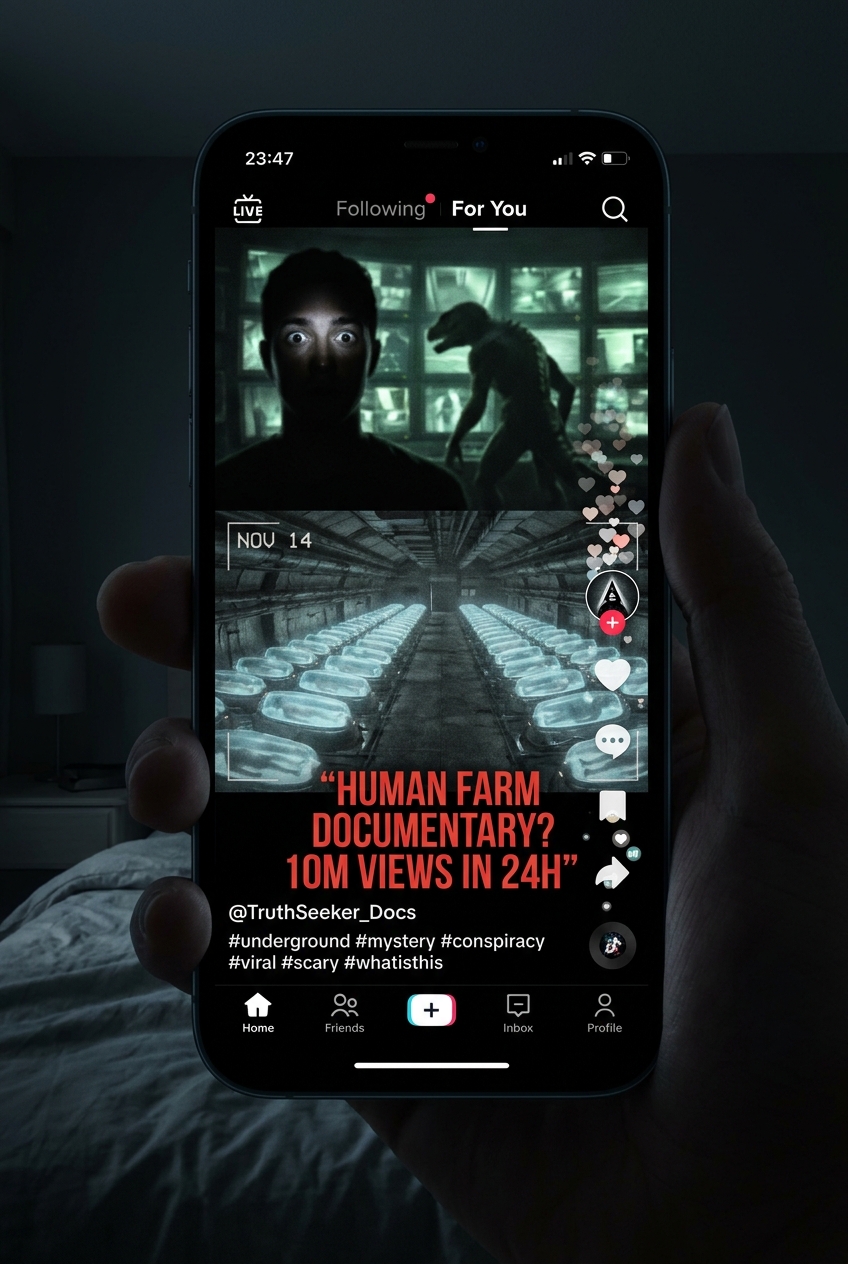
You are not weird for getting stuck on this TikTok clip. Most of us have trained ourselves to ignore creepy AI slideshows, fake documentaries and doomy voiceovers by now. Then one sneaks through anyway. The so-called human farm documentary TikTok viral video did exactly that. It mashed together underground bunkers, reptilian conspiracy talk, grainy surveillance-style footage and dead-serious narration, then somehow piled up millions of views. That leaves a very normal question rattling around in your head. Is anyone actually believing this stuff, or is the internet just rewarding whatever feels most disturbing? The short answer is that this kind of clip does not need to be true to spread. It just needs to be sticky. TikTok is very good at finding videos that trigger shock, disgust, curiosity and argument all at once. This one hit all four. Once you see how it works, it gets a lot less mysterious, and a lot less powerful.
⚡ In a Hurry? Key Takeaways
- The human farm documentary TikTok viral video blew up because it mixes horror-movie visuals, conspiracy language and comment-farming tricks, not because it is credible.
- If a clip feels urgent, outrageous and weirdly polished, pause and check for recycled footage, AI narration, missing sources and bait-style captions before sharing it.
- The real risk is not just believing one fake documentary. It is training your feed to send you more panic-bait and low-grade misinformation.
Why this one got under people’s skin
This was not just another silly internet hoax. It was built to feel half-plausible for a few seconds, which is often all TikTok needs.
The clip reportedly leaned on familiar conspiracy staples. Secret facilities. Hidden camera angles. Mentions of reptilians. Claims that “they” do not want you to know. None of that is new. What makes it effective is the packaging. It looks like a documentary trailer, not a random rant.
That matters because people are tired. You scroll fast. You catch fragments. A serious voice, eerie footage and on-screen text can create a quick feeling of authority before your brain has time to ask the obvious follow-up question, which is, “Wait, where is any real evidence?”
What the “human farm documentary” is really selling
Not facts. Attention.
The human farm documentary TikTok viral video works because it is less about proving a claim and more about creating a reaction loop. It wants you to do at least one of these things:
- Watch to the end because you are unsettled
- Rewatch to figure out what you just saw
- Read the comments to see if other people are buying it
- Share it with a friend and say, “What on earth is this?”
- Argue in the comments that it is fake
Here is the annoying part. TikTok often treats all of that as engagement. The platform does not need a clip to be trusted. It just needs people to stick around.
The tricks these clips use
1. Fake seriousness
A calm narrator can do a lot of heavy lifting. Add dramatic music, grayscale images and “classified” style text, and even nonsense can briefly feel official.
2. CCTV-style visuals
Grainy, low-quality footage feels “raw” to viewers. It suggests authenticity, even when the material is edited, AI-generated, ripped from other sources or stripped of context.
3. Conspiracy keywords people already know
Reptilians, underground tunnels, elites, hidden farms, surveillance. These are ready-made hooks. They trigger curiosity because people have heard pieces of them before.
4. Gaps instead of proof
Real documentaries give you names, places, dates and sources. Viral bait gives you mood. It leaves holes on purpose so viewers fill them with fear or speculation.
5. Rage-proof design
Even if you hate the video, you might still comment. “This is so fake.” “How do people believe this?” “Source?” Those are still signals that the clip is holding attention.
Did people actually believe it?
Some probably did. Plenty probably did not. But that is not the full story.
A lot of viral junk survives in the strange middle ground where viewers are not convinced, but they are fascinated. They share it ironically. They stitch it to mock it. They send it into group chats as a joke. They make reaction videos. And all of that can help it spread.
This is why “nobody really believes it” is not much comfort. A video can become huge through disbelief, curiosity and ridicule just as easily as trust.
Why TikTok is especially good at making this stuff feel huge
TikTok’s feed is great at spotting when a video creates a strong response quickly. Creepy content has a built-in advantage there.
If a clip makes you stop scrolling for even a second longer than usual, that matters. If people watch twice because they are confused, that matters too. If comments fill up with arguments about whether it is fake, that can keep it circulating.
So when you wonder how the human farm documentary TikTok viral video got 10 million views, the answer is not necessarily “millions of true believers.” It may just be “millions of people got snagged by the same psychological hook.”
How to tell when a “documentary” clip is really engagement bait
Check for actual sourcing
If a video makes huge claims but never names a source, film, reporter, location or date, treat it like entertainment, not evidence.
Look at the footage quality in a different way
Low quality can hide a lot. It can make edited footage look “real.” It can also mask AI-generated images or stitched-together clips from unrelated events.
Read the caption closely
Captions like “Why is nobody talking about this?” or “They keep deleting this” are classic bait. They are trying to make you feel like watching is an act of rebellion.
Use the comments wisely
Comments can be helpful if someone identifies the footage source. They can also be a swamp of roleplay, jokes and panic. Do not mistake volume for proof.
Search off-platform
If something this huge were real, there would be reporting, records and more than one spooky video montage. A quick search outside TikTok usually clears the fog fast.
Why this trend matters beyond one weird clip
This is bigger than one fever-dream video. It is part of a broader style of content that mixes AI tools, conspiracy aesthetics and platform-friendly editing.
You do not need a full fake movie anymore. You just need enough pieces to create the feeling of a movie. A few generated images. A dramatic script. A synthetic voice. Some stock footage. Done.
That is why these posts can feel so oddly polished now. They are cheap to make, fast to remix and easy to scale. One strange post becomes ten. Then fifty. Then it starts to feel like “everyone is talking about it,” when really the system is just feeding you versions of the same bait.
What to do if your feed starts filling up with this stuff
You are not powerless here.
Do not comment just to dunk on it
I know. It is tempting. But if you really want less of it, starving it of engagement often works better than quote-mocking it.
Use “Not Interested”
It sounds basic, but it helps. TikTok does take repeated signals into account.
Do not watch to the end unless you need to
Completion rate is a strong signal. If you can tell in five seconds that it is junk, keep moving.
Send context, not just the clip
If you share it with friends, add a note. Something like, “This is viral bait. Notice the missing sources and fake documentary style.” That keeps the conversation grounded.
The simple reality behind the hype
The most likely explanation is also the least glamorous. The human farm documentary TikTok viral video got big because it was engineered for modern attention, not because it uncovered a hidden truth.
It pushed emotional buttons. It looked spooky enough to feel memorable. It gave believers, skeptics and rubberneckers all a reason to interact. That is usually enough.
At a Glance: Comparison
| Feature/Aspect | Details | Verdict |
|---|---|---|
| Presentation style | Serious narration, ominous music, grainy “found footage” and documentary framing | Designed to feel credible before you stop to think |
| Evidence quality | Big claims, vague sourcing, recycled conspiracy language and little verifiable detail | Weak on facts, strong on mood |
| Why it spread | Shock, curiosity, argument, ironic sharing and rewatches all feed the algorithm | Classic engagement bait with a horror-conspiracy skin |
Conclusion
If this clip left you feeling creeped out and slightly annoyed, that is a pretty reasonable response. The whole thing is a near-perfect mix of creepy imagery, AI-assisted editing and TikTok’s love of outrage. That is why it feels bigger and more believable than it deserves. The good news is that once you spot the pattern, these videos lose a lot of their magic. You start seeing the missing sources, the stitched-together visuals and the emotional bait underneath the “documentary” act. That helps the community right now because the next panic-bait clip is already on its way. If you can recognize how the human farm documentary TikTok viral video spread, you are much less likely to let the next one hijack your feed, your mood or your group chat.