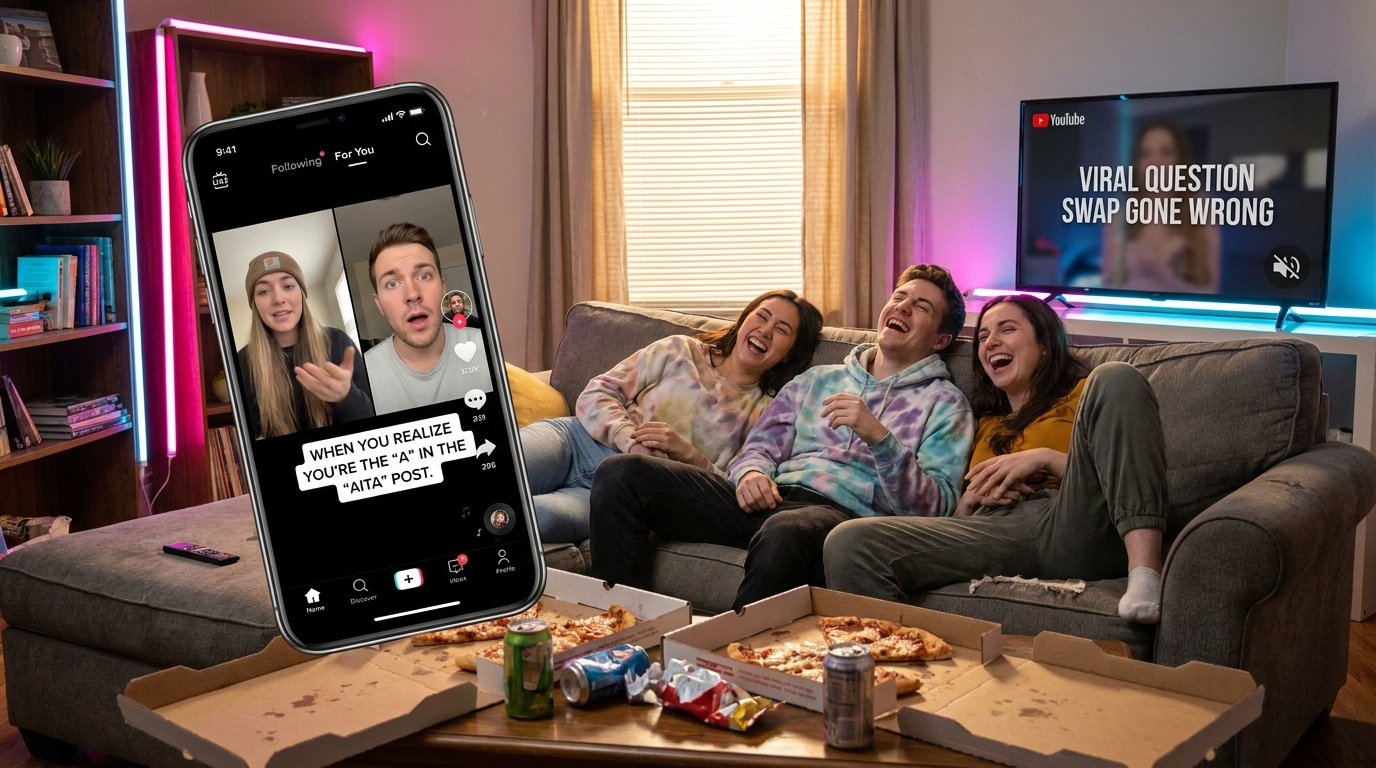
You know that weird mix of laughing and instantly regretting it when a prank video looks funny online, but you also know it would absolutely wreck your friend group if someone tried it on you? That is the energy behind the question swap viral video trend. The setup is simple. One person asks a harmless question, gets a normal answer, then edits in a totally different question so the answer suddenly sounds awful, creepy, or wildly incriminating. It is quick, cheap, and perfect for screenshots. That is also why people are paying attention. The joke lands because trust is doing all the work. The person answering assumes the clip will stay honest. Then the edit turns them into the villain of a thirty-second fake receipt. If you have ever worried about being quoted out of context, this trend is basically that fear with a ring light and a comment section.
⚡ In a Hurry? Key Takeaways
- The question swap viral video trend works by changing the question after someone gives an innocent answer, making them look like they said something they never actually agreed to.
- If a friend wants to film you for one of these, ask to hear the question on camera and see the final edit before it gets posted.
- It seems low-stakes, but out-of-context clips can spread fast, damage trust, and turn into fake receipts that are hard to clean up later.
What Is the Question Swap Trend, Exactly?
At its core, this trend is an editing trick disguised as a trust exercise.
Person A asks a question like, “Who is the funniest person here?” Person B answers honestly. Then the video cuts, and viewers hear a different question, maybe something mean or embarrassing. Suddenly the same answer sounds terrible.
That is the whole prank. No special effects. No deepfake. Just context switching.
And honestly, that is what makes it feel so believable. People are used to seeing jump cuts in short-form video. So the fake version can pass as real long enough to spread.
Why This One Is Blowing Up
The question swap viral video trend hits a very specific internet nerve. It is funny for about three seconds, then your brain catches up and goes, “Oh. That could go very wrong.”
It plays on three things people already worry about:
- Being misquoted
- Looking bad in screenshots
- Trusting the wrong person with a camera
That is why it is getting so much traction. It is not just a prank. It is a mini lesson in how easy editing can change meaning without changing your actual words.
Why It Feels So Much Worse Than a Normal Prank
Your real voice is still there
This is not someone putting words in your mouth with obvious dubbing. It is your face, your voice, your answer. Only the setup gets swapped. That makes the result feel more real, even when it is false.
It creates “proof” that is not really proof
Once clipped and reposted, it can look like evidence. People love receipts online, but bad edits can create fake receipts fast.
It can outgrow the joke
A prank between friends can leave the group chat and land on TikTok, Instagram Reels, YouTube Shorts, or X where nobody knows the backstory. Then it stops being an inside joke.
The Real Lesson Here Is Social, Not Technical
You do not need editing software skills to understand what this trend teaches. You just need to notice how trust works on camera.
Some people answer instantly because they trust the person filming. Some pause and ask, “Wait, what are you using this for?” That tiny pause is not paranoia. It is media literacy.
This is the same reason certain viral clips confuse people at first glance. The internet loves chopped-up context. If you saw people trying to figure out what was real in This Empire State Building ‘Skywalkers Proposal’ Clip Just Became The Internet’s New Favorite Reality-Glitch Romance, you have already seen how quickly a short video can make viewers fill in missing details on their own.
How to Protect Yourself Without Becoming “No Fun”
You do not need to treat every phone camera like a legal deposition. But a little caution helps.
Ask the question to be recorded clearly
If someone is filming a rapid-fire Q&A, make sure the question is audible in the same clip as your answer. That makes swapping harder.
Ask what platform it is going on
A joke for a private story is one thing. A public post is another. Audience matters.
Get posting permission straight first
A simple “Don’t post me if it gets weird” is not dramatic. It is normal.
Trust your hesitation
If a setup feels vague on purpose, there is probably a reason.
If Someone Already Used You in One of These
First, do not panic. Move fast and keep it boring.
- Ask them to remove it immediately.
- Save a copy in case it spreads.
- Post a calm correction if needed.
- If the clip affects school, work, or safety, report it on-platform and document everything.
The calmer you are, the easier it is to show what happened. “This was edited to swap the original question” is a lot stronger than a long angry thread.
When the Joke Crosses the Line
There is a difference between a harmless bait-and-switch and something that could damage a reputation.
If the swapped question makes someone appear racist, abusive, dishonest, predatory, or disloyal, that is not just awkward content. That can have real fallout.
Friendships can take a hit. Relationships can take a hit. Jobs and school situations can get messy fast if a clip escapes its original audience.
That is the part worth talking about, especially with younger users who have grown up around constant filming. “It was just a joke” does not magically stop a misleading clip from spreading.
What Parents, Teachers, and Friend Groups Can Take From This
This trend is actually useful as a low-stakes conversation starter.
You can use it to ask:
- Would you let someone post an edited clip of you for laughs?
- How would you prove a video changed the meaning of what you said?
- What counts as consent when filming friends?
- What should happen if a prank starts affecting real life?
Those are better questions than just “Was the video funny?” because they get at the real issue. Not every viral trend is about technology. A lot of them are about judgment.
At a Glance: Comparison
| Feature/Aspect | Details | Verdict |
|---|---|---|
| How the prank works | A normal answer is kept, but the original question is replaced with a different one in the edit. | Clever, but misleading by design. |
| Risk to the person on camera | They can look mean, guilty, or inappropriate even though they never answered that version of the question. | Higher risk than it first appears. |
| Best way to stay safe | Make sure the full question and answer are recorded together, and set rules before posting. | Simple and worth doing. |
Conclusion
The question swap viral video trend is funny right up until you picture your own face in the clip. That is why it matters. Today this helps the community by translating a chaotic viral prank into a quick social literacy check: who around you blindly trusts the person holding the camera, who actually thinks about how their words can be chopped up, and how easy it is for a thirty-second clip to spin into fake “receipts” that follow you across platforms. Instead of just laughing at another gotcha video, readers walk away with a concrete feel for how out-of-context editing works and a low-stakes way to talk about consent, digital footprints, and what you would do if the joke stopped being funny and started messing with someone’s real life.