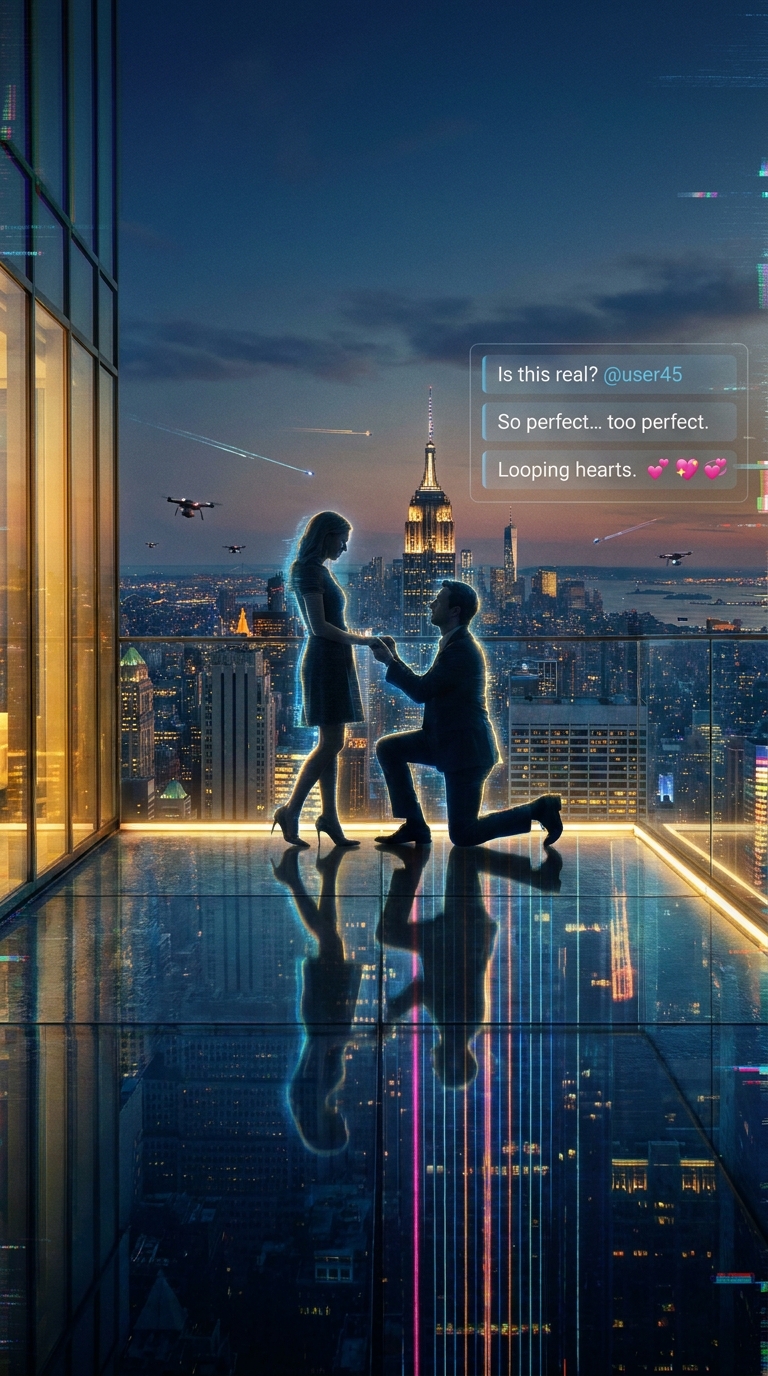
You are not imagining it. That glossy “couple on a skyscraper roof” clip that looks like an engagement scene from a $200 million movie probably is not a real video at all. The viral AI skyscraper couple viral video trend is exactly the kind of thing that makes normal people feel a little tricked, because it is built to look emotional first and believable second. One swipe and you see a perfect skyline, dramatic wind, glowing skin, movie-camera blur, and two people staring at each other like a perfume ad. It is weirdly convincing. It is also often generated or heavily altered by AI tools that can turn an ordinary photo or simple prompt into “cinematic” footage in seconds. The good news is you do not need to become a forensic editor to spot it. Once you know a few tells, the whole fake-proposal, fake-rooftop-romance thing gets much easier to recognize.
⚡ In a Hurry? Key Takeaways
- This viral skyscraper couple clip is usually AI-generated or heavily AI-enhanced, not a real captured moment.
- Check hands, background movement, lighting shifts, and text overlays. Those are still some of the easiest clues.
- The real risk is not just being fooled. It is getting emotionally hooked by moments that never happened, then sharing them like they are real.
What people are actually seeing on their feeds
The clip changes a little depending on who reposts it, but the formula is the same. A stylish couple stands on a rooftop, balcony, or skyscraper ledge. The city behind them looks huge and dreamy. The camera glides like a drone and a Hollywood dolly had a baby. Everything is too pretty. Too smooth. Too perfect.
That is why so many people stop and think, “Wait, is this a real proposal, a brand ad, or some AI thing?” Fair question. The answer is often: AI thing.
These videos are usually made with text prompts, image-to-video tools, or “cinematic” one-tap templates that add fake camera motion, film-style color grading, shallow depth of field, and dramatic facial expressions. You do not need a studio anymore. You need an app, a prompt, and about as much patience as it takes to order coffee.
Why this trend suddenly feels like it is everywhere
AI video tools got easier fast. What used to live inside niche creative software is now baked into consumer apps and social platforms. That means more creators, meme pages, and brands can make something that looks expensive without actually filming anything expensive.
The “skyscraper couple” style works especially well because people already expect romance content to look polished. Throw in sunset lighting and a dramatic skyline, and your brain fills in the gaps. It feels real because it borrows every visual clue we associate with movie trailers and luxury ads.
So, is the clip fake?
In many cases, yes. Either fully generated, partly generated, or heavily transformed by AI.
That middle category is where the confusion starts. Some videos begin with real source material, like two people standing on a balcony, then get pushed through AI tools that change the camera movement, facial detail, lighting, wardrobe texture, and even the city itself. So viewers argue in the comments because one person means “there were real humans somewhere in the process,” while another means “this final clip is not a trustworthy recording of a real event.” Both can be true.
How to spot an AI skyscraper couple viral video
1. Watch the hands first
AI still struggles with hands, rings, fingers touching, and small grip changes. In a proposal-style clip, this matters a lot. You may see fingers blend together, jewelry shift shape, or a hand seem to slide through hair or fabric in a way that looks just a bit off.
2. Look at the edges of moving people
Hair, coat hems, shoulders, and jawlines can shimmer or warp slightly as the camera “moves.” Real video can blur too, of course. But AI blur often looks painterly or inconsistent from one frame to the next.
3. Check the skyline
Buildings in the background may bend, duplicate windows, change shape, or drift in strange ways. A city skyline should not behave like jelly. If the Empire State Building looks a little too tall in one second and weirdly softened in the next, that is a clue.
4. Notice the lighting
In real footage, light usually behaves consistently. In AI clips, skin glow, reflections, and shadows can shift for no clear reason. One cheek might brighten while the rest of the frame does not. The sun may appear to be in three places at once.
5. Listen for the audio mismatch
A lot of these clips use generic emotional music because raw sound would give the game away. If there is speech, lip movement may not line up cleanly. If there is ambient city noise, it may sound oddly flat or disconnected from the space you are seeing.
6. Read the caption carefully
Sometimes the giveaway is not visual. It is social. Captions like “shot on iPhone,” “cinematic moment,” or “can’t believe he did this” may leave out where it happened, who made it, or whether it is a concept piece. If a creator is weirdly vague, that can be intentional.
A simple test you can use in 10 seconds
Here is the easy repeatable method.
Pause. Zoom. Replay.
Pause on faces and hands. Zoom in on jewelry, fingers, and hairlines. Replay the background for building movement and lighting changes. If two or three things feel slippery at once, trust that instinct. Most people can sense something is off before they can explain why.
Why people get fooled so easily
Because the goal is not technical perfection. It is emotional speed. These clips are designed to hit you before your brain starts asking questions. You see romance, scale, luxury, drama. By the time you wonder if it is fake, you have already watched it twice and maybe sent it to a friend.
That does not make you gullible. It makes you human.
Does it matter if it is fake, if it is “just for fun”?
Sometimes it really is just a joke or an aesthetic trend. No harm done. But it starts to matter when fake moments are posted as real life milestones, brand campaigns blur the line on purpose, or viewers build real emotional reactions around something that never happened.
This is the bigger shift. AI video is moving from “look what this software can do” to “look at this moment you are supposed to feel.” That is a much stronger kind of persuasion.
What creators and brands are likely to do next
Lean into it. Hard.
Expect more fake rooftop kisses, impossible luxury travel scenes, dramatic reunions, and “engagements” that look too polished to be true. Some will be clearly labeled. Some will not. Some brands will treat the uncertainty as part of the fun because comments arguing about whether a clip is real are great for reach.
What you should do before sharing one
If it matters, verify. If it is just a meme, label it like a meme.
A good habit is to ask three quick questions:
- Who posted it first?
- Do they say how it was made?
- Does anything in the clip behave in a way real cameras and real people usually do not?
If the answer to the last one is yes, maybe do not share it as “OMG this is beautiful and real.” Share it as “this AI clip is weirdly convincing.” That tiny wording change helps everyone.
At a Glance: Comparison
| Feature/Aspect | Details | Verdict |
|---|---|---|
| Visual polish | Hyper-smooth camera motion, perfect skin, dramatic skyline, movie-style blur | Looks impressive, but “too cinematic” is often the first clue |
| Human details | Hands, rings, hair, teeth, and facial edges may warp or shift between frames | Best place to check for AI artifacts |
| Context and caption | Often vague about location, creator process, or whether it is generated | If the source is fuzzy, treat the clip as entertainment, not evidence |
Conclusion
The useful thing about this week’s AI skyscraper couple viral video is that it gives us one clear example of a much bigger change. AI video filters and one-click cinematic prompts are no longer niche toys. They are becoming normal feed content, and people are getting emotionally wrapped up in scenes that were never real moments. Once you know what to look for, the confusion drops fast. You can enjoy the joke, spot the trick, and keep your friends from falling for the next suspiciously perfect balcony proposal in the group chat. That is the real win here. Not panic. Just better instincts, better language, and a little less getting played by the algorithm.