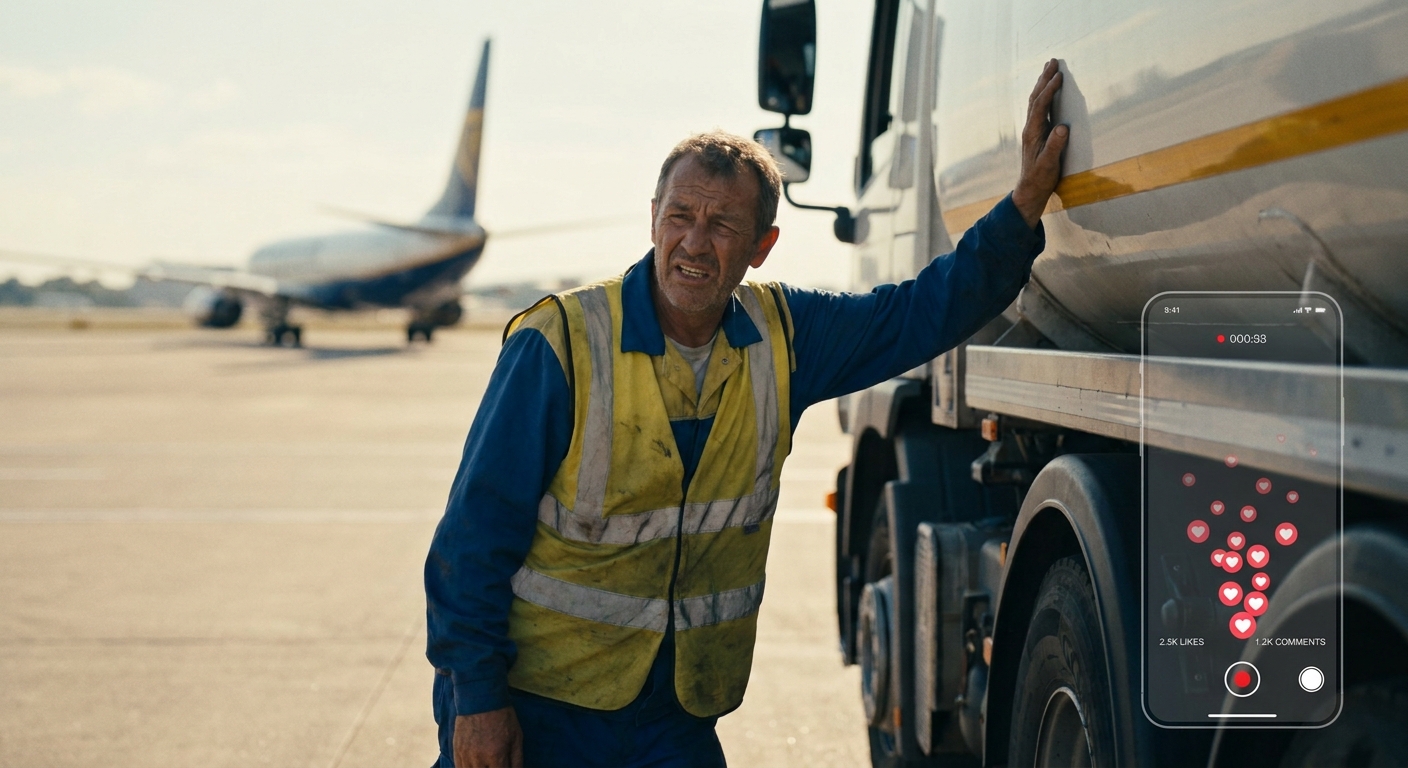
Most viral clips feel exhausting. Somebody is getting humiliated, somebody is yelling, and the algorithm keeps asking you to care. So when a viral airport tarmac video shows something painfully real instead, people notice fast. That is exactly what happened when viewers saw an airport fueler, later identified in reports and fundraising posts as a Navy veteran, visibly struggling with serious knee pain while doing his job on the tarmac. The video was raw, short, and hard to watch for all the right reasons. It did not feel staged. It felt human. Then the internet did something rare. Instead of turning the moment into a joke, people started asking who he was, what he needed, and how to help. In less than a week, that concern turned into a fundraiser that surged past $135,000. For once, the comments were not the worst part of the story. They were the reason it changed his life.
⚡ In a Hurry? Key Takeaways
- This viral airport tarmac video led to a Navy veteran fundraiser that topped $135,000 after viewers saw him working through obvious pain.
- If you want to help in moments like this, verify the fundraiser source first, then share the original appeal with context instead of reposting random copies.
- The real value here is bigger than one donation total. It shows how a short, honest clip can push the internet toward empathy instead of cheap outrage.
What happened in the viral airport tarmac video?
The clip that caught fire online showed an airport worker fueling planes while clearly struggling to move. Viewers focused on his gait right away. He looked like someone trying to push through intense knee pain because he had no choice but to finish the shift.
That detail is what made the video land. There was no soundtrack trying to force emotion. No prank setup. No big speech. Just a man at work, hurting, in plain view.
As the video spread, people in the comments began piecing together more of the story. The worker was described as a veteran, specifically a Navy veteran, and attention quickly shifted from “this is awful to watch” to “how do we actually help him?” That is when the fundraiser took off.
Why this one spread so fast
It felt real immediately
People are pretty good now at spotting clips built for clicks. This one had the opposite energy. It looked unfiltered. The pain looked genuine. That made viewers stop scrolling.
It gave people a clear next step
A lot of emotional videos go nowhere because there is no bridge between feeling bad and doing something useful. In this case, once a verified fundraiser link started circulating, the internet had a simple action. Donate. Share. Repeat.
It tapped into something bigger
This was not only about one worker on one runway. It hit a nerve because it reflected a broader fear people already have. Many workers, including veterans, are trying to manage pain, bills, and physically demanding jobs at the same time. The video put a face to that reality in a few seconds.
How the fundraiser climbed past $135,000
The pattern was familiar in one sense and unusual in another. First came the clip. Then came outrage, but not the performative kind. It was concern. After that, someone connected the attention to a fundraising page, and momentum built very quickly.
Once donations start rolling in on a story like this, social proof takes over. A person sees the total at $5,000 and thinks, “People care.” They see it at $25,000 and think, “This is real.” By the time it crosses six figures, the fundraiser itself becomes part of the story.
That is what happened here. The internet likes movement. A total that keeps climbing gives people a reason to check back in, reshare, and pull in more donors. It becomes a loop, but a helpful one.
Why the comments mattered this time
Usually, the comment section is where nuance goes to die. Here, it helped push the story in a useful direction. People were identifying the worker, asking for trustworthy links, and urging others not to make him the butt of the joke.
That shift matters. Viral attention is not automatically good. It can expose someone without helping them. In this case, the crowd pressure moved toward support instead of mockery. That is rare enough that people noticed it as part of the story itself.
What makes a “good” viral video different from empty drama?
It shows a real problem
The strongest clips are often simple. You understand the issue in seconds. Here, viewers saw physical pain and economic pressure without needing a long explanation.
It leaves room for dignity
That is a big one. A good viral moment does not just farm sympathy. It creates a path to help while still treating the person on screen like a human being, not content.
It points people toward action
Awareness is fine. Action is better. The reason this story broke through is that it turned a scroll-by moment into practical support.
If you want to amplify stories like this, do these three things
1. Check the source before sharing
Look for the original poster, local reporting, or a fundraiser that clearly explains who set it up and where the money is going. Viral kindness works best when it is tied to something real and traceable.
2. Share the help link, not just the clip
If the goal is support, make the support easy to find. Reposting the video alone can turn a person’s pain into spectacle. Reposting it with verified context gives people a useful next step.
3. Resist turning the person into a symbol
It is fine to say the story stands for something bigger. Just do not erase the actual person in the process. He is not a motivational meme. He is someone who was hurting and needed help.
The bigger lesson for the internet
The viral airport tarmac video navy veteran fundraiser story is not just a feel-good detour. It is a reminder that the internet still responds to sincerity when it sees it. Under all the noise, people are hungry for proof that online attention can still do something decent.
That may be why this clip hit so hard. It offered a break from the usual cycle of rage and sarcasm. It showed a problem that looked immediate and fixable. Then thousands of strangers decided not to just comment, but to show up.
At a Glance: Comparison
| Feature/Aspect | Details | Verdict |
|---|---|---|
| The video itself | Short, raw clip showing an airport fueler visibly working through knee pain on the tarmac. | Powerful because it felt authentic, not staged. |
| Public reaction | Commenters moved from shock to support, asking for verified details and sharing donation links. | A rare example of social media doing something useful. |
| Fundraiser impact | Donations passed $135,000 in under a week, turning a painful moment into life-changing help. | Proof that the right kind of viral attention can matter. |
Conclusion
This story landed because it gave people something they have been missing online for a while. A reason to believe the internet can still be human. A quick, raw video of an airport fueler fighting through obvious knee pain became more than a sad clip. It became a real-world rescue, with a Navy veteran fundraiser racing past $135,000 in days. That is why people cannot stop talking about it. It cut through the usual outrage machine and showed what happens when viewers choose empathy over snark. And there is a useful lesson in that for the rest of us. When a good viral moment appears, the best move is not to just react. It is to verify, share responsibly, and help push attention toward something that actually improves a person’s life. That is the kind of internet worth feeding.