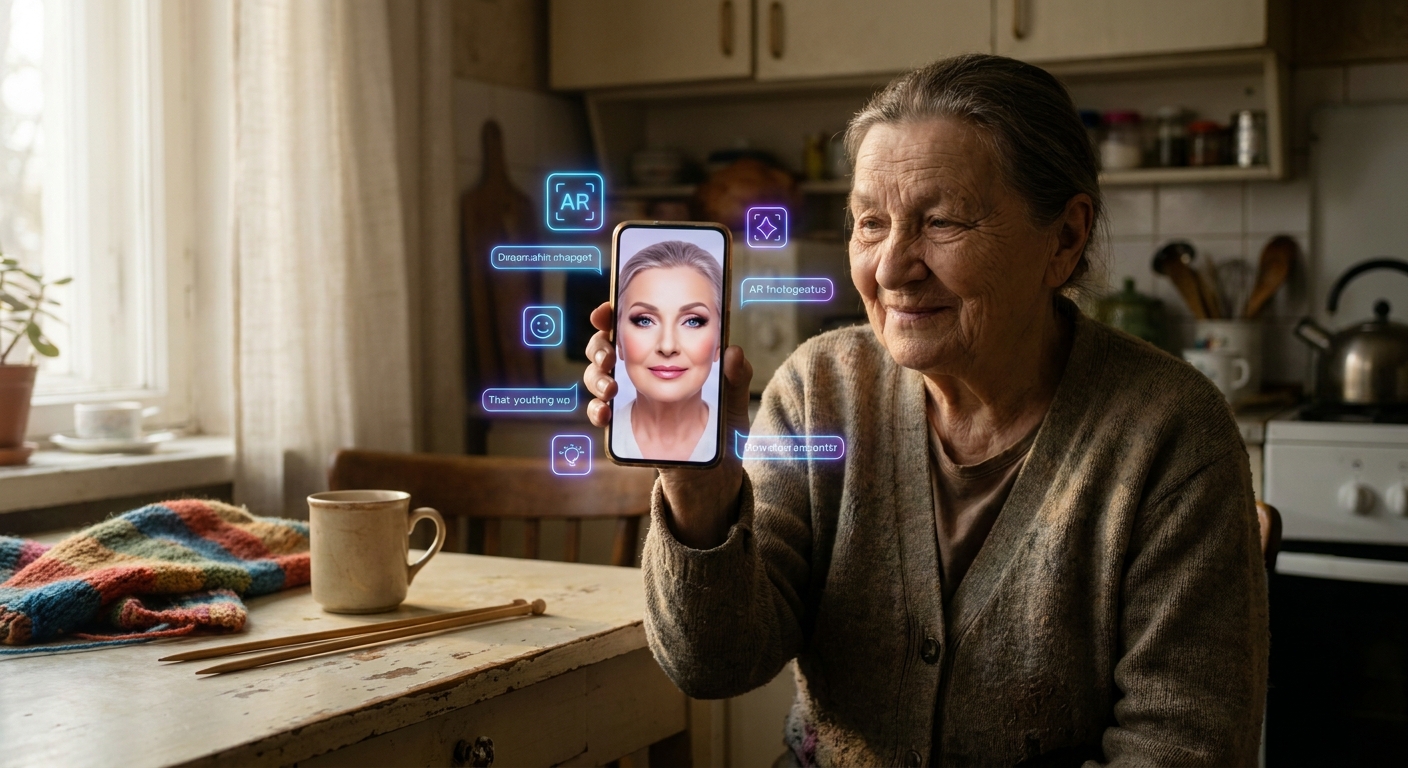
If your social feeds have started to feel like a parade of impossibly smooth skin, tiny noses, and suspiciously perfect cheekbones, you are not imagining it. A lot of what looks “normal” online now is being quietly polished by AI. That is why this viral grandma AI makeup TikTok video hit such a nerve. An 82-year-old grandma appears on screen, and within seconds an AI beauty filter gives her the full glow-up treatment. Soft skin. Lifted features. Bigger-looking eyes. The result is funny, weird, impressive, and just unsettling enough to make people stop scrolling. The clip works because it lands in that very modern sweet spot where you laugh first, then immediately think, wait, what exactly am I looking at? And honestly, that reaction is useful. It is a small reminder that many of the faces flooding your feed are not faces in the old-fashioned sense. They are edited performances happening live.
⚡ In a Hurry? Key Takeaways
- This viral clip is popular because it shows, very clearly, how powerful AI beauty filters have become.
- If a face online looks oddly perfect, assume a filter or face-shaping effect may be involved and avoid comparing yourself to it.
- The real value here is media literacy. Once you know how these effects work, they lose some of their power over your brain.
Why this clip blew up so fast
The video is built for the internet’s current mood. People are tired of fake perfection, but they are still fascinated by it. So when an older woman gets transformed into something that looks halfway between a beauty influencer and a game character, the contrast is impossible to ignore.
Part of the appeal is wholesome. People love seeing grandmothers join in on internet jokes. But the bigger reason this specific clip spread is that it makes AI beauty filters visible in a way they usually are not. On younger creators, the same smoothing and face reshaping can pass by almost unnoticed. On an 82-year-old face, the change is dramatic enough that everyone can see the trick.
That makes the video both entertaining and revealing. It is basically a magic trick where the camera forgot to hide the wires.
What the filter is actually doing
This is not old-school makeup in the normal sense. It is software mapping a face in real time and then changing key features frame by frame.
Skin smoothing
The filter reduces wrinkles, pores, shadows, and texture. Real skin has detail. AI beauty tools tend to erase it first.
Feature reshaping
Many of these effects subtly lift brows, slim the jaw, narrow the nose, enlarge the eyes, and plump the lips. Some do it so gently you barely notice. Others crank it up until the face starts looking a little doll-like.
Color correction
Filters also add warmth, brighten under-eyes, even out skin tone, and create the look of blush, contour, and highlight without any actual makeup brush touching the skin.
Motion tracking
The creepy impressive part is that the effect sticks to the face as the person moves. That is why it feels more convincing than a simple photo edit. The app is tracking landmarks like eyes, nose, mouth, and chin, then repainting the face in real time.
Why it feels funny and uncanny at the same time
Your brain is good at spotting when something is slightly off. Not fake enough to be a cartoon. Not real enough to be natural. That in-between zone is where a lot of AI beauty content lives.
With the viral grandma AI makeup TikTok video, the mismatch is extra strong. You are seeing an older person’s natural expressions paired with a filter aesthetic that is usually designed for teenage and twenty-something beauty culture. The result is jarring. It is a bit like hearing your grandma suddenly speak in influencer slang. You understand all the parts, but together they feel surreal.
That weirdness matters because it helps people notice the manipulation. Usually, filters work best when you do not think about them at all.
The bigger issue hiding underneath the joke
This is where the clip stops being just a meme. AI filters are slowly shifting what people think a normal face should look like. Not celebrity faces. Not ad campaign faces. Everyday faces.
That has consequences. If you spend enough time looking at AI-smoothed skin and algorithm-shaped features, your own reflection can start to feel strangely “wrong,” even when nothing is wrong at all. That is not vanity. That is repetition doing its job.
And because the edits now happen in video, not just selfies, they can feel more truthful than they are. People still tend to trust moving images more than still ones, even though real-time beauty filters can now rewrite both.
How to spot an AI beauty filter without needing a tech degree
You do not need forensic software. A few simple clues help.
Look at the skin
If the skin looks uniformly blurred, with almost no texture even in bright light, that is a giveaway.
Watch the jawline and cheeks
If the face seems unusually sculpted or seems to hold the exact same flattering shape from every angle, a face-shaping filter may be active.
Check the eyes and lashes
Beauty filters often make eyes slightly bigger and lashes darker, even when the person is not wearing much makeup.
Notice the “too stable” look
Real faces change a lot with movement, lighting, and expression. Filters try to keep everything looking polished all the time. That can create a strangely locked-in perfection.
Read the caption or effect label
Sometimes the simplest answer is right there. TikTok creators often tag the filter, use a beauty effect label, or joke about it openly.
What to do if this stuff is messing with your head
The goal is not to become the filter police. It is to protect your own brain a little.
First, pause before comparing yourself to anyone on screen, especially on short-form video apps. Ask one question. “Is this a person, or a person plus software?” The answer is very often the second one.
Second, keep at least some part of your feed human. Follow creators who show bare skin, changing light, normal aging, and ordinary faces. It sounds small, but your standards reset based on what you see repeatedly.
Third, treat viral beauty clips like special effects, not evidence. If an 82-year-old can be turned into a glass-skinned influencer in seconds, then the issue is not your face. It is the tool.
Should people stop using these filters?
Not necessarily. Filters can be playful. They can be funny. They can even help people experiment with makeup looks before buying products. The problem starts when entertainment quietly becomes expectation.
That is the line worth watching. If a filter is clearly a joke, fine. If it is being used to sell a fantasy as everyday reality, that is when people get misled.
And to be fair, most viewers already know some editing is happening. What they often do not realize is how advanced and automatic it has become. That is why clips like this one are oddly helpful. They show the machine at work in a way people can actually feel.
At a Glance: Comparison
| Feature/Aspect | Details | Verdict |
|---|---|---|
| Why it went viral | The dramatic before-and-after effect on an 82-year-old face makes AI beauty editing impossible to miss. | Funny on the surface, revealing underneath. |
| How the effect works | Real-time face mapping smooths skin, changes facial proportions, and adds digital makeup and color correction. | Very advanced, and increasingly hard to spot at a glance. |
| Why it matters | Repeated exposure to synthetic beauty can distort what people think normal faces should look like. | Worth paying attention to, especially if social media affects your self-image. |
Conclusion
The best thing about this bizarre little grandma glow-up moment is that it gives people a chance to laugh and learn at the same time. AI filters and beauty tech are quietly rewriting what “normal” looks like, and most of us absorb that without really stopping to think about it. So if this viral grandma AI makeup TikTok video made you do a double take, good. That means your instincts are still working. Once you understand how these effects smooth, sculpt, and polish a face in real time, they become easier to enjoy without taking them personally. And that is the upgrade that matters. Not better fake skin. Better judgment while you scroll. In a week where everyone is a little tired of perfection but still glued to the feed, that is genuinely useful.