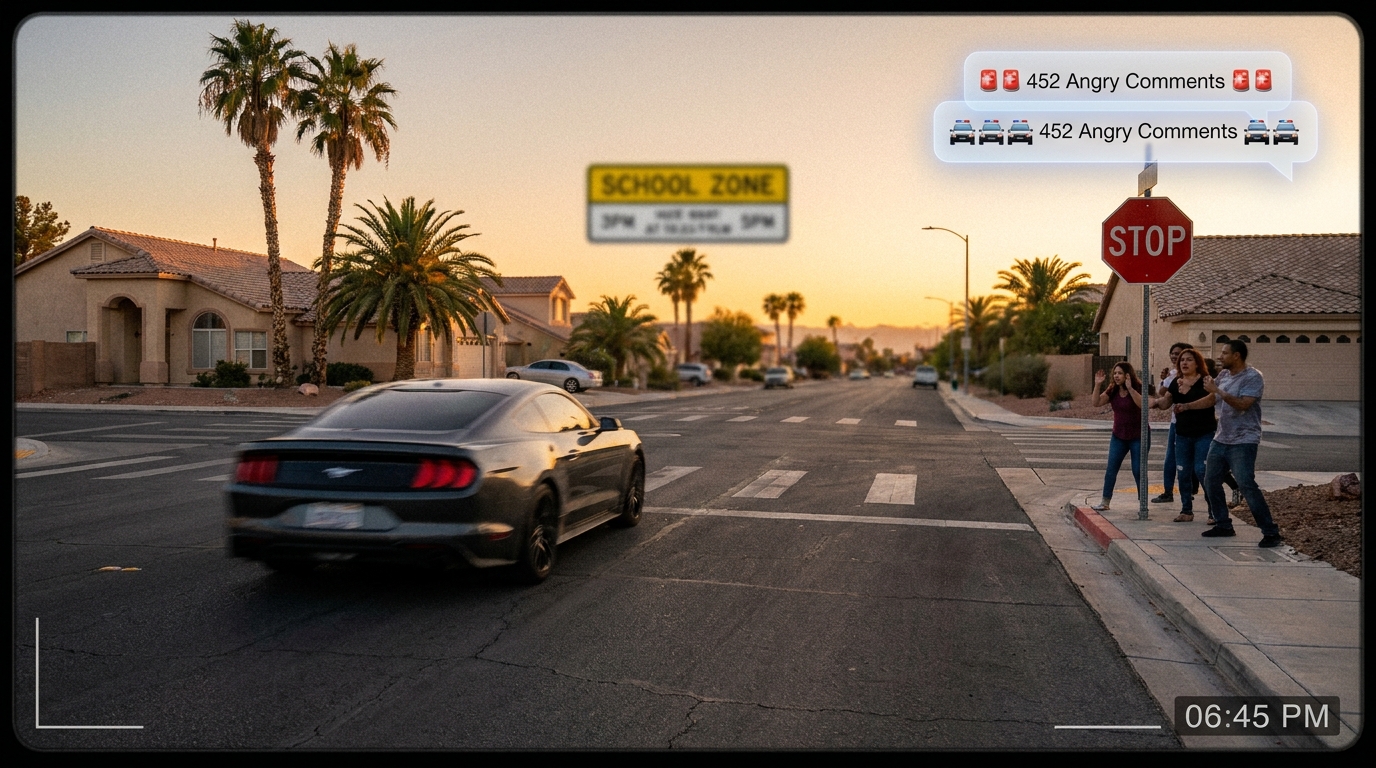
You know the feeling. You open your feed for five minutes, hoping for a dumb meme or a dog video, and instead you get dropped into a pile-on halfway through. That is exactly what happened with the Las Vegas stop signs are a scam viral video. By the time most people saw it, the original clip had already been reposted, stitched, captioned, slowed down, and turned into a running joke. The problem is, this one was not harmless. The now-infamous dashcam clip appears to show a driver blasting through a Las Vegas residential area, ignoring stop signs while the caption “stop signs are a scam” flashes like it is all one big bit. Nineteen seconds. That was enough to trigger local outrage, spread far beyond Reddit, and reportedly draw police attention. If you were wondering what actually happened, why people are so angry, and why this clip feels different from normal internet nonsense, here’s the plain-English version.
⚡ In a Hurry? Key Takeaways
- The Las Vegas stop signs are a scam viral video blew up because it appears to show real reckless driving in a neighborhood, not a harmless prank.
- If you see a clip like this early, check for the original source, local reporting, and whether law enforcement has responded before repeating half-true reposts.
- The bigger story is about clout chasing, public receipts, and how fast communities can turn a short video into evidence, backlash, and real-world consequences.
What happened in the video?
The clip that set this off is short, which is part of why it spread so quickly. It appears to be dashcam footage from a car moving fast through a Las Vegas residential street while stop signs are ignored. The phrase “stop signs are a scam” turns the whole thing into a joke, or at least tries to.
That joke did not land. Not with locals, and not with people who have ever had to live near speeding traffic.
Viewers were not just reacting to bad taste. They were reacting to the mix of speed, neighborhood streets, visible traffic controls, and the casual framing of it all. A lot of viral clips are dumb. This one looked dangerous in a way people recognized immediately.
Why did this clip hit harder than the usual brain-rot post?
Most viral nonsense burns out because it feels fake, low-stakes, or obviously staged. The Las Vegas stop signs are a scam viral video broke through because it felt like a real person showing off behavior that could get someone badly hurt.
There are three reasons people latched onto it.
1. It had a clean villain
The internet loves a simple story. A short clip. A reckless choice. A caption that sounds smug. You do not need much context for viewers to decide who the bad guy is.
2. It involved a residential area
This matters. People are more likely to shrug at reckless driving on an empty highway clip than they are when it seems to happen near homes, intersections, and the kind of streets where kids, pets, cyclists, and pedestrians exist.
3. The caption did a lot of damage
Without “stop signs are a scam,” this might have stayed a local anger post. With it, the clip became easy to summarize, easy to mock, and easy to share. It gave the internet a ready-made label.
How it spread from local outrage to national attention
This is the part many people miss when they only see the stitched version later.
Viral clips like this often start in local spaces first. A neighborhood Facebook group. A city subreddit. A local X or TikTok account. That early audience brings something the wider internet does not have. Context.
Locals know the roads. They know whether the area is busy. They know if the driving shown is unusually reckless or just obnoxious. They also tend to care more because it happened in their backyard.
Once that local anger starts producing screenshots, reposts, and timeline threads, larger accounts swoop in. Then the clip stops being “a bad thing that happened here” and becomes “the internet’s main character of the day.” That seems to be what happened here. A local clip turned into national outrage, then reportedly into police interest.
Why people are calling it a “villain origin story”
Because the internet now loves the moment before the downfall. Not just the scandal itself, but the exact clip where someone seems to volunteer for infamy.
That is what makes this feel like a villain origin story to so many viewers. The driver is not shown making a mistake and apologizing. The clip is framed like a flex. That changes everything.
When someone posts or appears in a video that treats risky behavior as content, the audience tends to do two things at once. First, they meme it. Second, they start collecting receipts. Usernames, reposts, deleted captions, earlier clips, comments, local reports. The internet can be chaotic, but it is surprisingly organized when it decides to be mad.
The bigger issue: clout chasing that stops being funny
This is why the story matters beyond one person and one clip.
We are in a stretch of internet culture where people keep pushing the line to get noticed. Louder prank. Bigger stunt. More obvious provocation. Usually the reward is attention. Sometimes it is sponsorships, followers, or just a short burst of fame.
But the backlash pattern is getting just as predictable.
If the stunt looks like it could hurt bystanders, people stop treating it as “content” and start treating it like evidence. That is the switch. Once that switch flips, the conversation changes from “Can you believe this idiot?” to “Can someone identify this car?” or “Has anybody sent this to police?”
That is exactly why this clip struck a nerve. It landed right in the middle of a bigger public mood. People are tired of watching basic safety get traded for views.
How to tell when the next viral clip is about to become a pile-on
If you want to spot the pattern early, here are the signs.
It is short and easy to caption
Nineteen seconds is perfect for outrage. There is no setup, no nuance, and no breathing room. Just a clean, shareable shock.
The person seems proud, not embarrassed
People react much more strongly when the clip feels boastful. A dumb mistake can get sympathy. A dangerous brag usually gets torched.
There is a built-in phrase people can repeat
“Stop signs are a scam” is sticky. It is absurd, memorable, and instantly tells people what side they are on. That kind of line helps a clip travel.
Locals show up fast with context
When people from the area start adding street details, local concerns, and possible IDs, the story often jumps from viral joke to serious backlash.
Authorities get tagged early
Once users begin tagging police departments, city officials, or local news, the clip has crossed into consequence territory.
What to do before you share a clip like this
You do not need to become a digital detective, but a little caution helps.
Look for the earliest version you can find
Reposts strip out context. Try to find where the clip first appeared and whether the caption changed along the way.
Check local reporting or official statements
If the story has moved beyond memes, local reporters or law enforcement often confirm the basic timeline faster than national aggregators do.
Separate what is visible from what is assumed
It is fair to describe what the video appears to show. It is less smart to repeat unverified claims about who was driving, what happened next, or what charges may be coming.
Do not confuse outrage with proof
The internet is good at spotting patterns. It is also very good at getting details wrong in the first few hours.
Why communities are using “receipts” more than ever
One of the most interesting parts of stories like this is how quickly online communities move from reacting to archiving.
People save mirrors of the clip. They screenshot captions. They compare deleted posts. They preserve comments before accounts go private. That is what people mean when they talk about bringing receipts. Not just opinions, but a trail.
That shift matters because it changes the power dynamic. For years, rage bait and reckless posts often vanished before any real accountability showed up. Now the audience knows how to document things before they disappear.
Used carefully, that can help push back on dangerous behavior. Used carelessly, it can also fuel misidentification and mob logic. So yes, receipts matter. But so does restraint.
At a Glance: Comparison
| Feature/Aspect | Details | Verdict |
|---|---|---|
| What made it viral | A short dashcam clip, reckless-looking driving, and the sticky caption “stop signs are a scam.” | Perfect recipe for fast outrage. |
| Why people were furious | It appeared to happen in a residential area and framed a safety risk like a joke. | This felt dangerous, not merely annoying. |
| What it says about internet culture | Audiences are increasingly willing to turn viral stunts into documented accountability campaigns. | Clout can turn into consequences very fast. |
Conclusion
The reason this story stuck is simple. It taps into the exact tension people are feeling right now. Too many creators and wannabe creators act like attention is worth any risk, while the public is getting faster at pushing back with screenshots, reposts, and local context. By unpacking how a Las Vegas speed run through a residential street, tagged with “stop signs are a scam,” jumped from a local subreddit to national outrage and a police investigation, you have the full picture instead of just the meme scraps. That gives you better language for talking about online clout chasing without sounding preachy or lost. It also helps you spot the pattern early. Short clip. Smug caption. Local anger. Receipts. Then the mainstream pile-on. Once you see that formula, the next villain of the week is a lot easier to recognize before your whole feed catches up.