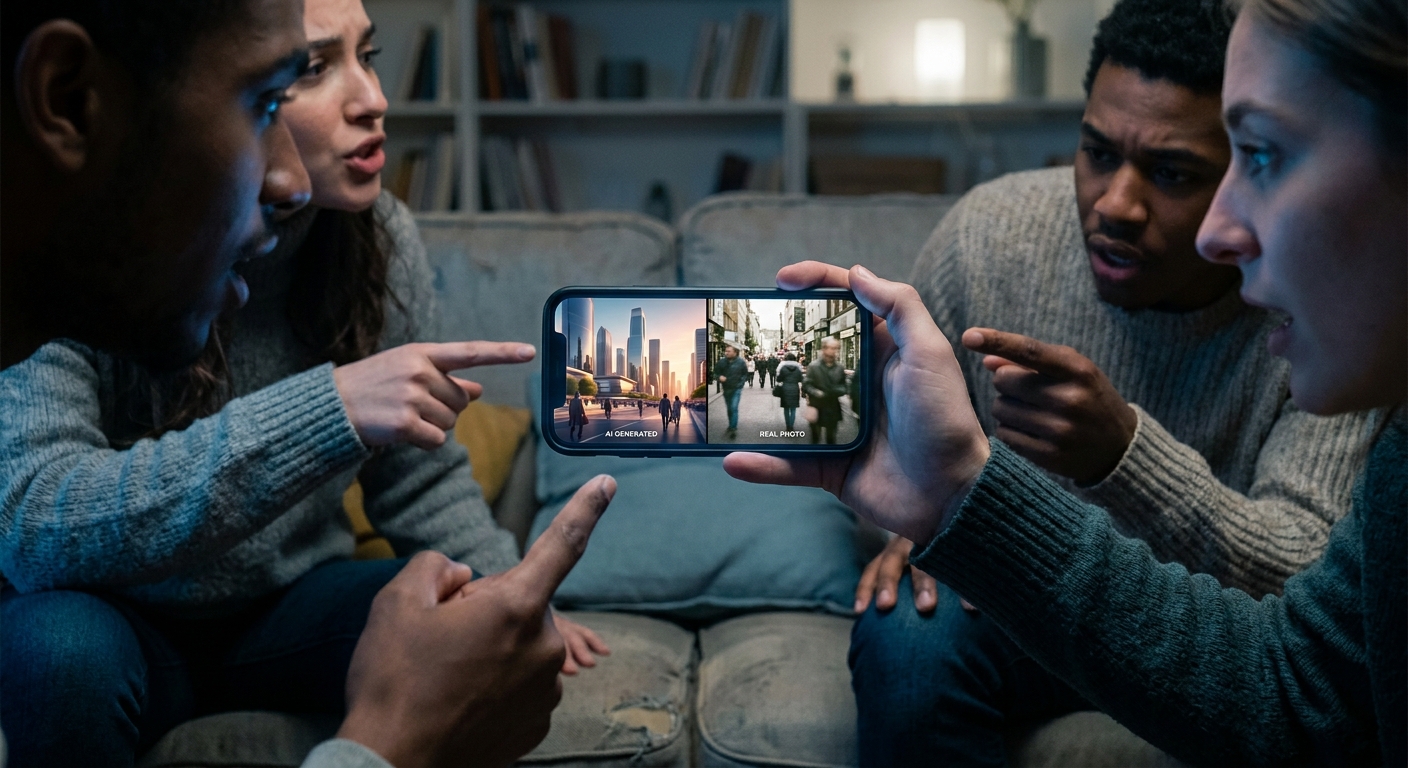
You are not crazy if your brain now does a double take every time you see a perfect selfie, a weirdly glossy vacation photo, or a celebrity clip that feels just slightly off. A lot of us scroll with that low-level suspicion now. Is this real, edited, or fully made by AI? That is exactly why the viral AI or real TikTok filter video trend is blowing up. It takes that background anxiety and turns it into a game. TikTok users are being shown images and asked one simple question: is it an AI image or a real photo? The catch is that people keep getting humbled. Badly. What makes this trend worth your time is not just the laughs. It is that it teaches you, very quickly, how easy it is to be fooled by polished skin, strange lighting, too-perfect symmetry, and fake little details that your eyes usually skip right past.
⚡ In a Hurry? Key Takeaways
- The viral AI or real TikTok filter video trend asks users to guess whether an image is AI-made or an actual photo, and many people are getting it wrong.
- Use the filter as practice. Look for hands, teeth, background text, lighting, reflections, and tiny details that often give AI away.
- This is not just a meme. It is a useful little media literacy workout that can help you avoid getting fooled by fake content online.
Why this filter suddenly feels so personal
The reason this trend hits a nerve is simple. It is not asking about some distant future problem. It is exposing a problem you already have every time you open your phone.
Your feed is full of content that sits in a blurry middle ground. Some posts are real but heavily edited. Some are AI-assisted. Some are complete fakes. And most of the time, nobody stops to label them clearly.
So when this filter pops up and starts testing people in public, the reactions are half comedy and half panic. You watch confident users guess wrong three times in a row, then stare at the camera like their trust in the internet just left their body.
That is why the trend works. It is funny, but it also feels uncomfortably relevant.
What the viral AI or real TikTok filter video actually does
The format is pretty straightforward. The filter shows an image, or creators stitch clips and screenshots into the same guessing game format, then asks whether what you are seeing is AI-generated or a genuine photo.
Sometimes the answer feels obvious. Sometimes it really does not.
The trick is that modern AI image tools are now very good at making things that feel emotionally and visually believable at first glance. They know how to mimic DSLR depth of field, phone camera blur, makeup styles, food photography, travel shots, and candid portraits.
That means your old telltale signs are not always enough anymore. We all used to joke about six fingers and melted earrings. Those still happen, but the harder fakes now miss in subtler ways.
The biggest reason people keep failing
Most of us do not actually look at images. We scan them.
We notice the vibe first. Pretty person. Fancy apartment. Cute dog. Stunning sunset. Then we move on. AI thrives in that kind of fast scrolling because it only needs to feel real for two seconds.
This filter forces you to slow down. Once you do, things start to stand out.
The clues people are learning to spot
One of the most useful parts of this trend is that commenters and editors keep comparing notes. Over time, a nice little crowd-sourced checklist has formed.
1. Hands and fingers
Yes, this is still a classic for a reason. AI has improved, but hands remain weirdly fragile. Look for extra fingers, fused fingers, unnatural bends, or hands that seem posed in a way no human joints would allow.
2. Teeth and eyes
Sometimes AI makes smiles too uniform, too glossy, or strangely dense. Eyes can also have an uncanny symmetry or a glassy look that feels more designed than photographed.
3. Background text
Signs, labels, menus, shirt graphics, book spines. AI still struggles with text a lot. If the words look almost correct but not quite, that is a major clue.
4. Lighting that is a little too perfect
Real photos usually have some messiness. A blown-out highlight. A soft shadow in the wrong place. AI images often look polished in a suspiciously even way, like every surface got its own beauty light.
5. Jewelry, glasses, and reflections
Tiny objects reveal a lot. Earrings may not match. Eyeglass arms can disappear. Reflections in mirrors or windows may not line up with the person or scene.
6. The “too smooth to be true” effect
Skin texture, fabric texture, wood grain, fur, and food all matter here. If everything looks airbrushed but the creator is claiming it is a random candid snapshot, your gut may be right.
Why this trend is bigger than just one filter
What is really going viral is not the tool itself. It is the shared feeling behind it.
People are tired of not knowing what they are looking at. They are tired of getting baited by fake celebrity photos, invented travel scenes, and deepfake clips passed around as fact. This trend gives that frustration a shape. It turns confusion into a challenge people can talk about.
In that sense, it works a lot like other TikTok waves that start as entertainment and then become a running internet conversation. You can see a similar pattern in things like This TikTok ‘Europeans Try American Food’ Clip Just Became The Internet’s New Culture War Comedy Hit, where one simple format suddenly becomes everyone’s argument, joke, and reaction post for a week.
The difference here is that this one might actually leave you smarter.
How to use the trend without getting overconfident
This is the important part. Spotting AI in a game is useful practice, but it does not make anyone a human lie detector.
Some real photos will look fake. Some AI images will look completely convincing. That is normal now.
Good habits to keep
If a photo is being used to sell you something, outrage you, or push a dramatic claim, do more than eyeball it.
Check the source. Look for the original poster. See whether trusted outlets or reverse image search results back it up. If it is a video, pay attention to lip sync, blinking, lighting shifts, and audio that feels pasted on.
Think of the filter as a warm-up, not the final exam.
Do not assume “real-looking” means true
Even if an image is a real photograph, it can still be misleading. It may be old, cropped, staged, or posted with a false caption.
That is why media literacy now means more than just asking, “Was this made by AI?” It also means asking, “Who posted this, why did they post it, and what am I supposed to feel or do after seeing it?”
Why regular people and pro editors both love this trend
Regular users like it because it is fun to test themselves and roast their own bad guesses.
Editors, designers, and photographers like it because it opens the door to a bigger conversation. Once people realize they can be fooled, they become much more open to learning how digital images are built, altered, framed, and shared.
That “aha” moment matters. It is the difference between passive scrolling and active looking.
And honestly, that is a useful skill now whether you care about tech or not.
At a Glance: Comparison
| Feature/Aspect | Details | Verdict |
|---|---|---|
| Entertainment value | Fast, funny, and easy to join because the guessing game format works instantly. | Very high. That is why it spread so fast. |
| Learning potential | Teaches people to notice image details like text errors, odd hands, fake reflections, and over-smoothed textures. | Surprisingly useful as beginner media literacy practice. |
| Real-world reliability | Helpful for training your eye, but not enough on its own to verify viral claims or suspicious posts. | Good first check, not a final answer. |
Conclusion
If this trend made you realize you are worse at spotting AI than you thought, welcome to the club. That is not a failure. It is the whole point. The viral AI or real TikTok filter video is more than another disposable meme. It is a quick, funny, low-stakes way to train your eyes in a feed full of fakes, edits, and half-truths. And that helps the community right now. The best reactions and breakdowns give people a fast path to becoming a little less gullible and a lot more alert. In a world where most people just keep scrolling, even a small pause to ask “wait, is this real?” is a very good habit to build.