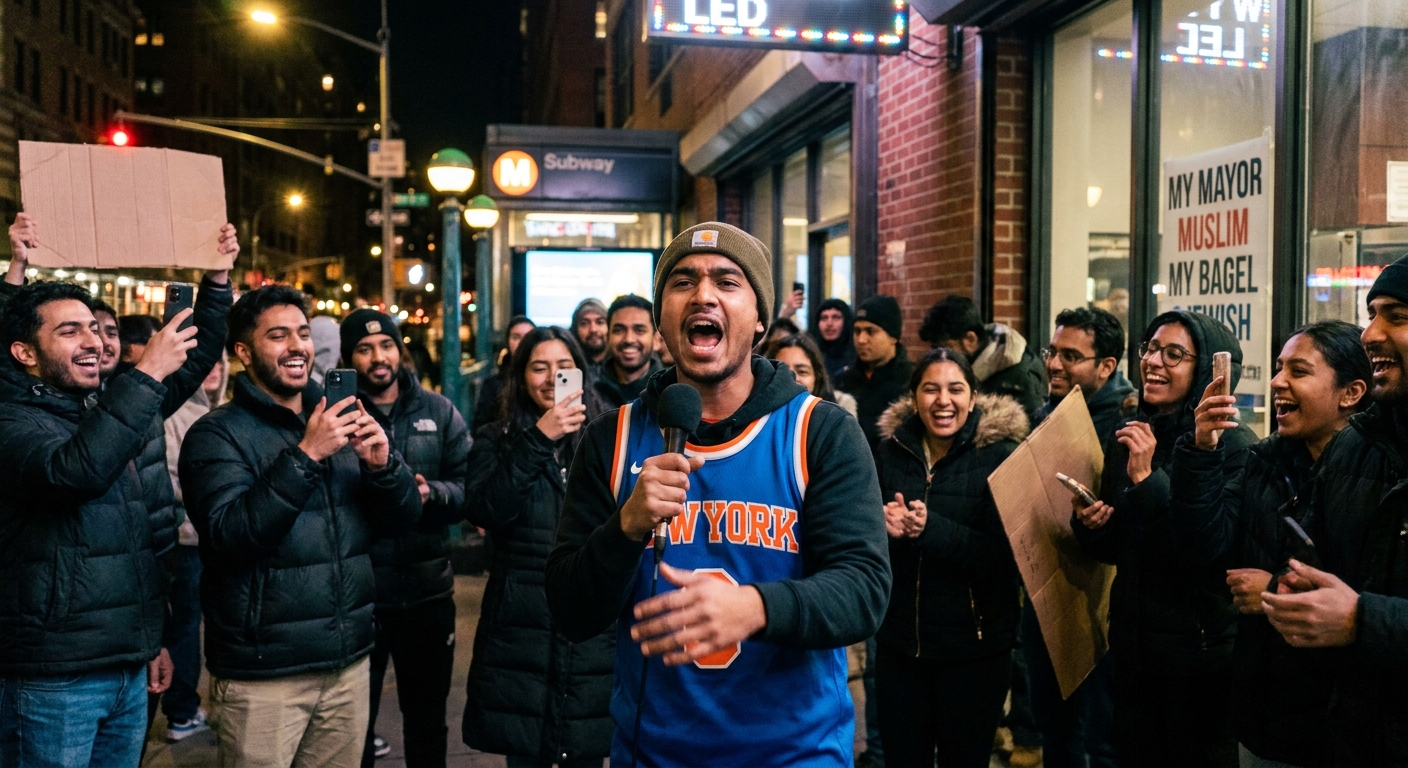
If your phone has been yelling “my mayor Muslim, my bagel Jewish” at you all weekend, you are not alone. This one Knicks clip has spread so fast that the internet has already done what it always does. It stripped away the original moment, copied it a thousand times, and turned a quick street interview into a full-blown cultural inside joke. That gets annoying fast, especially when you just want to know who said it first, why people are laughing, and which repost is actually worth sending to someone else.
Here’s the short version. The now-famous chant came out of the wild, happy street energy around the Knicks’ championship celebration, when fans were pouring New York pride into anything that sounded catchy enough to repeat. The line hit because it was funny, rhythmic, oddly wholesome, and deeply New York all at once. It felt like a block party slogan, not a polished meme. That authenticity is exactly why it escaped sports circles and landed everywhere from TikTok edits to X quote-posts to Reddit threads trying to decode whether it was satire, sincerity, or both. The answer is simple. It was a real fan moment first, then the internet did the rest.
⚡ In a Hurry? Key Takeaways
- The “my mayor Muslim my bagel Jewish Knicks viral video” started as a real street-level Knicks celebration clip and took off because it sounded funny, proud, and unmistakably New York.
- If you want the original context, look for the earliest raw street interview versions, not polished reposts with captions, reaction boxes, or added music.
- The best part of this meme is not just the joke. It captures a joyful, mixed-up, plural New York at the exact moment the city was celebrating big.
Why this 10-second chant blew up so fast
Some viral clips spread because they are shocking. Others spread because they are useful. This one spread because it was instantly repeatable.
The line has a beat to it. You hear it once, and your brain already knows how to say it back. That matters on TikTok and Instagram, where people grab anything that can become a sound. A good viral sound needs to be short, weird, and easy to drop into a new joke. This chant checks every box.
It also arrived at the perfect moment. Knicks fans were already flooding feeds with celebration videos, street interviews, subway screaming, and parade energy. So when one clip summed up the whole city in a few words, people latched on.
What the chant actually means
This is where people outside New York sometimes miss the joke.
The line works because it turns everyday city diversity into a brag. Not a lecture. Not a policy statement. A brag. It says, in effect, this place is a glorious mix of everybody and everything, and that mix is part of the fun. That is why the phrase feels both absurd and affectionate.
“My mayor Muslim, my bagel Jewish” sounds funny because it crashes civic identity and food identity together in one breath. But it also lands because it reflects a real New York style of talking. Fast, proud, a little chaotic, and very specific.
The real reason people keep reposting it
Most memes die when they leave their original setting. This one got stronger.
Why? Because people could bend it into almost any format. Sports victory montage. Exam stress joke. Group chat caption. Fake campaign slogan. Sketch-comedy bit. The structure is so simple that creators can swap in their own version and still keep the rhythm.
It became a template, not just a clip
That is the internet sweet spot. Once a quote becomes a template, it stops belonging to one platform. TikTok uses the sound. Instagram uses the reel caption. X turns it into text jokes. Reddit turns it into a thread about where it came from. Then mainstream comedy grabs it too.
That is how a short Knicks street chant turns into MCAT memes and Saturday Night Live references in what feels like five minutes.
So what is the original?
If you are trying to find the source, here is the trick. Skip the reposts with giant subtitles, split-screen reactions, or extra music laid over the top. The original-style versions are usually messy, loud, vertical phone clips from the celebration itself. Street noise. Crowd energy. Somebody on camera who sounds like they are inventing the line in the moment, not reading a scripted bit.
That roughness is part of the proof. Viral moments like this usually feel a little unplanned because they are.
If a clip looks too polished, it is probably a repost, a media pickup, or a parody. Those can still be funny. They are just not the root of the joke.
How to tell the original from a parody
This is the part that drives people nuts once a meme goes fully mainstream.
Signs you are looking at the likely original clip
Look for raw phone video, uneven framing, crowd noise, and a speaker who seems to be riffing naturally. The funnier the line sounds without editing help, the more likely it is close to the source.
Signs you are looking at a remix
If it has text overlays explaining the joke, dramatic zooms, laugh-track style edits, or someone lip-syncing the audio in a totally different setting, you are in remix territory.
Again, that is not a bad thing. It just means you are watching the meme after it already escaped into the wild.
The smartest remixes so far
The strongest remixes are not the ones that simply repeat the line. They are the ones that understand why it works.
The good ones keep the proud, hyper-local energy. They swap in different identities, foods, neighborhoods, professions, or fan bases while keeping the same rhythm. That is why the best posts feel like tributes, not knockoffs.
The weaker versions tend to flatten the joke into “random = funny.” That misses the point. The original line feels alive because it sounds tied to a real place and a real moment.
Why this matters beyond the meme
It is easy to dismiss all this as just another internet sound. But this clip hit a nerve for a reason.
At a moment when online culture often feels angry, fake, or algorithmically manufactured, this one felt human. It came from a real crowd, during a real celebration, with a kind of messy joy that cannot be focus-grouped.
And because the chant centers difference in a playful, proud way, people saw more than a sports joke in it. They saw a little snapshot of how New York talks about itself when it is happy.
If you want one clip to share, share the context too
If you are sending this to a friend who keeps asking what the joke is, do them a favor. Do not just drop a random remix with no explanation. Share a raw celebration clip or at least explain that this was a real Knicks victory-weekend fan moment that got memed into orbit.
That tiny bit of context changes the whole thing. Suddenly it is not just another line the internet ran into the ground. It becomes a piece of city culture.
At a Glance: Comparison
| Feature/Aspect | Details | Verdict |
|---|---|---|
| Original clip | Raw street interview energy, crowd noise, spontaneous delivery during Knicks celebration | Best for understanding the joke |
| Remix versions | Edited captions, reused sound, parody formats, brand and creator spins across platforms | Best for seeing how far the meme spread |
| Cultural value | Captures plural New York pride during a historic Knicks championship weekend | More than a throwaway sports meme |
Conclusion
This chant earned its place because it is not just catchy. It is a tiny, funny record of a city celebrating itself in public. That is why the “my mayor Muslim my bagel Jewish Knicks viral video” keeps bouncing around your feed. It started as a real moment, then became the soundtrack for everybody else’s joke. Knowing the backstory helps you skip the worst reposts, understand why people latched onto it, and share the version that actually means something. And that matters. This is not just the internet being loud for no reason. It is the defining viral video of a historic Knicks championship weekend, and a snapshot of joyful, plural New York at full volume.