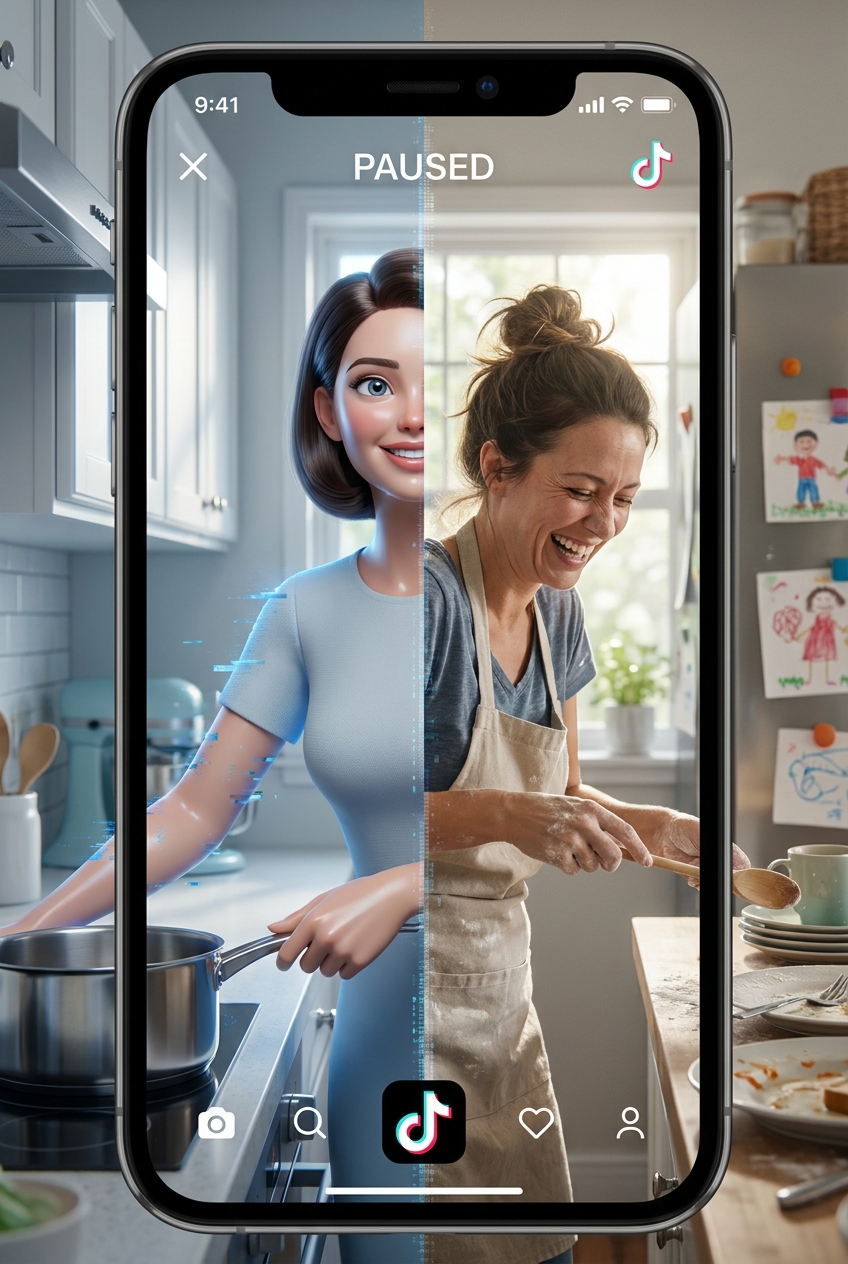
Your brain is not broken if the ai mom vs real mom viral tiktok video made you do a double take. That is the whole point. Feeds are full of clips that look almost real, then one tiny detail makes everything feel off. A smile lands a second too late. A hand bends strangely. The light on a face does not match the room. Suddenly a silly kitchen bit turns into a mini trust crisis. That is why this one hit so hard. It is funny at first, but it also shows how fast most of us accept a synthetic face as a real person when the setting feels familiar. A kitchen helps. A “mom” character helps even more. It feels safe and normal, so your guard drops. The good news is this viral clip is also a great practice round. If you can learn to spot the weird bits here, you will be much better at catching the next fake that slides into your feed.
⚡ In a Hurry? Key Takeaways
- The ai mom vs real mom viral tiktok video works because it mixes a normal home setting with just-good-enough face generation that tricks your brain for a few seconds.
- Pause the clip and check hands, eyes, teeth, shadows, and lip sync. Those are still the easiest places to catch AI fakery.
- Do not share first and question later. Funny fake videos are harmless until they train you to trust the next one too quickly.
Why this one is blowing up
The “AI Mom vs Real Mom” kitchen clip is easy to get sucked into because it uses a format people already know. Two characters. Same room. Simple joke. Fast payoff. Nothing about it screams “high tech experiment.” It looks like the kind of family skit millions of people scroll past every day.
That is exactly why it matters.
When AI shows up in a sci-fi setting, your brain stays alert. When it shows up next to a fridge, a wooden spoon, and a familiar parent trope, your brain relaxes. You stop inspecting and start watching. That little shift is where a lot of modern deepfake content slips through.
What viewers are noticing after the first laugh
The comments on videos like this usually follow the same path. First it is, “lol the AI mom is terrifying.” Then a few people replay it and say, “Wait, is the other one real?” After that, the whole comment section becomes a detective club.
That turn from joke to confusion tells you a lot. It means the fake is not perfect, but it is close enough to make people doubt their own first impression. And right now, that is all AI really needs to do to spread.
How to spot what is off
1. Watch the lighting, not just the face
Faces generated or altered by AI often look smooth enough on first glance. Lighting is where things start to fall apart. In the kitchen clip, the room light may stay consistent while the face seems to brighten, flatten, or shift tone between frames. Real skin reflects light in a messy, natural way. AI skin can look a bit too even, or change in a way that does not fit the room.
A good test is to focus on the cheeks, forehead, and jawline during movement. If the person turns and the light does not behave naturally, your fake alarm should start buzzing.
2. Hands still give the game away
AI has improved a lot with hands, but not enough to trust them. Fingers may blur together, bend oddly, pop in and out of shape, or grip objects in a way that feels wrong. In cooking videos, this gets even easier to spot because hands are doing lots of quick, practical motions.
If the face looks fine, jump to the hands. They are still one of the best truth tests on the internet.
3. Eyes can look alive, but not quite human
Eyes are another giveaway. You may notice a stare that feels too fixed, blinking that looks mistimed, or pupils and reflections that do not match the rest of the scene. Sometimes both eyes track perfectly in a way real people almost never do on casual phone video.
If a clip feels creepy and you cannot explain why, it is often the eyes. Your brain catches the mismatch before you can put it into words.
4. Teeth and mouth movement are sneakier clues
Teeth in AI-altered videos can look too perfect, too flat, or strangely bright from one frame to the next. Lip sync can also drift. The mouth forms the right general shape, but not at the exact right moment. In a fast, funny kitchen skit, your brain may forgive that. On a second watch, it stands out.
This is one reason comedic videos are such a smart test case for AI creators. The pace hides little mistakes.
Why the kitchen setting matters so much
A kitchen is one of the most believable places on the internet. It is ordinary. We know what family behavior looks like there. We know how someone reaches for a mug, leans on a counter, or reacts to a joke while cooking. That familiarity fills in gaps for the fake.
In other words, the setting does some of the lying for the AI.
That is what makes the ai mom vs real mom viral tiktok video more useful than it first appears. It teaches a basic media literacy lesson. The more normal the setting feels, the less skeptical people become.
This is not just about one prank
This week it is a kitchen skit. Next week it is a fake celebrity apology, a made-up news anchor clip, or a child’s face altered for a joke that spreads without context. The same habits apply across all of them.
You do not need to become a forensic video analyst. You just need a better pause button. Before you react, ask a few boring questions. Does the lighting match? Do the hands make sense? Do the eyes track naturally? Does the audio feel clean in a suspicious way? Is the account labeling the bit clearly, or farming confusion for views?
How to enjoy viral AI clips without getting played
Assume entertainment first, authenticity second
If something is funny, weird, and suspiciously polished, treat it like a special effect until proven otherwise. That does not ruin the fun. It just stops you from becoming free promotion for a fake.
Read the comments, but do not trust them blindly
Comments can help surface clues, but they can also make the confusion worse. Some people are joking. Some are guessing. Some are very confidently wrong. Use comments as hints, not proof.
Check the creator’s other posts
A lot of accounts using AI filters or synthetic faces are not hiding it that well. Their feed usually tells the story. If every video has the same uncanny quality, that is your answer.
Slow the video down
This sounds basic because it is. Replay at half speed if your app allows it, or scrub frame by frame. AI often survives normal playback but falls apart under even mild scrutiny.
What this says about where social video is heading
The strange part is not that AI can make a fake mom in a kitchen. The strange part is how little quality it now needs to be believable enough. A few years ago, bad AI faces looked obviously broken. Now they only need to hold up for three seconds to win the scroll.
That is the future-feels-weird part. Not perfect fakes. Plausible ones. Cheap ones. Funny ones. Ones that slide into your feed dressed as harmless nonsense.
At a Glance: Comparison
| Feature/Aspect | Details | Verdict |
|---|---|---|
| Facial realism | Looks convincing at full speed, especially in a familiar kitchen setting, but skin texture and expression timing can drift on replay. | Believable enough to fool a quick scroll, not strong enough to survive close inspection. |
| Body language and hands | Hands, finger positions, and object handling may look awkward or briefly warped during fast motions. | Still one of the easiest places to catch AI. |
| Viewer impact | Starts as a joke, then makes people question what they just watched and whether either person is real. | A funny clip that doubles as a useful lesson in online skepticism. |
Conclusion
The big value of the ai mom vs real mom viral tiktok video is not just that it is weird and shareable. It is that it gives people a safe, obvious example of how easily synthetic faces can slip past us when the setting feels normal. Once you see the lighting glitches, the odd hand behavior, the slightly off eyes, and the comment section sliding from “haha” to “hold on,” you start building a better filter in your own head. That helps the community right now because deepfake celebrity clips, fake news anchors, and AI kids are all landing in the same feeds. Learning to decode one chaotic kitchen prank makes you better at questioning the next hundred videos that show up. That is how you stay in on the joke without becoming the punchline.